Mumbai’s growing population, increasing traffic, and expanding infrastructure create a continuous demand for well-planned road construction and maintenance. From urban streets and commercial roads to highways and industrial access routes, every project requires the right combination of machinery, skilled operators, and efficient planning.
However, completing road construction projects in Mumbai is not always straightforward. Heavy traffic, limited working space, unpredictable monsoon rainfall, and tight deadlines can make construction activities more complicated. Traditional methods may also require additional time and labour when handling large-scale excavation, levelling, paving, and compaction work.
Modern road construction equipment helps address these challenges by making construction activities faster, more precise, and easier to coordinate. Using appropriate machinery can improve productivity, reduce unnecessary material wastage, and support consistent road quality.
For a Road Construction Company In Mumbai, understanding how modern equipment contributes to project efficiency is essential for delivering reliable infrastructure while managing time and operational costs.
1. Why Is Modern Equipment Important for Road Construction?
Road construction involves several interconnected activities, including site preparation, excavation, soil stabilisation, grading, material transportation, paving, and compaction. Delays in one activity can affect the entire project schedule.
Modern construction machinery helps contractors perform these tasks with greater efficiency and consistency. Instead of relying entirely on manual work, construction teams can use specialised equipment designed for specific operations.
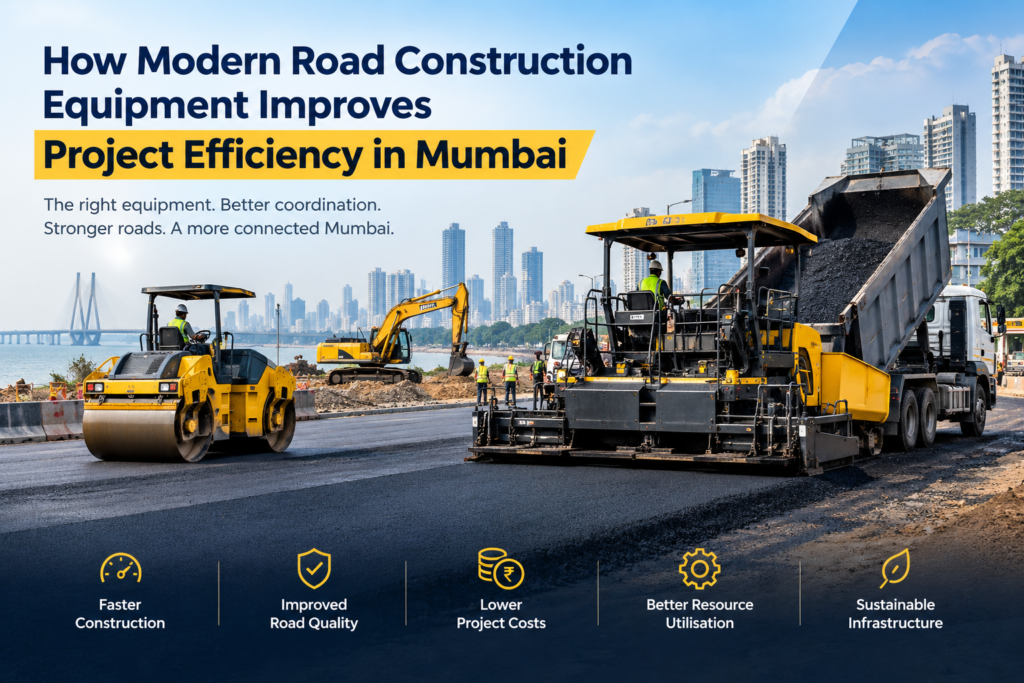
For example, excavators can handle earthmoving, motor graders can level surfaces, and road rollers can compact construction materials. When these machines operate according to a well-organised schedule, different stages of the project can progress more smoothly.
The main benefits include:
- Faster completion of repetitive construction activities.
- Reduced dependence on labour-intensive processes.
- Better control over construction quality.
- Improved coordination between work stages.
- More efficient utilisation of materials and resources.
Selecting equipment according to project requirements is particularly important in Mumbai, where contractors often need to work within restricted spaces and minimise disruption to surrounding traffic.
2. How Do Excavators and Earthmoving Machines Improve Productivity?
Site preparation is one of the first and most important stages of road construction. Before laying the road surface, contractors must prepare the ground, remove unsuitable materials, and create the required foundation.
Excavators and other earthmoving machines help complete these activities efficiently.
Excavators are commonly used for digging, removing soil, preparing drainage trenches, and handling construction materials. Their attachments can also be selected according to the work involved.
Wheel loaders and suitable material-handling equipment help move soil, aggregates, and other construction materials around the site. This reduces the time required for manual handling and supports a more organised workflow.
Modern earthmoving machinery can help contractors:
- Prepare large areas in less time.
- Move heavy materials more efficiently.
- Improve site preparation accuracy.
- Reduce manual handling of bulk materials.
- Maintain progress across different construction stages.
For urban road projects, equipment size and manoeuvrability should be considered carefully. Compact machinery may be more suitable for restricted sites, while larger machines can offer greater productivity where sufficient working space is available.
3. How Do Motor Graders Improve Road Surface Preparation?
A stable and properly levelled foundation is essential for constructing durable roads. Uneven ground can affect the thickness of subsequent layers and contribute to drainage problems or premature pavement deterioration.
Motor graders are designed to level, shape, and finish surfaces during road construction. Their adjustable blades allow operators to distribute materials and achieve the required gradients according to engineering specifications.
Accurate grading helps create a suitable base for subsequent construction activities, including compaction and paving.
Modern grading equipment can improve efficiency by reducing repeated levelling work and helping operators achieve more consistent results.
Proper surface preparation is especially important in Mumbai because effective drainage plays a significant role in managing monsoon rainfall. Roads must be constructed with suitable slopes and drainage arrangements to help prevent water accumulation.
Although graders improve precision, the final outcome also depends on correct surveying, material selection, operator skills, and compliance with the project’s engineering design.
4. How Do Road Rollers Improve Construction Quality?
Compaction is an essential step in building a strong road structure. Soil, aggregates, and asphalt must be compacted appropriately to achieve the required density and stability.
Road rollers and other compaction machines help apply controlled pressure or vibration to construction materials. The appropriate machine depends on the material being compacted, the layer thickness, and the required specifications.
Different types of rollers serve different purposes.
Vibratory rollers: These are commonly used to compact granular materials and suitable pavement layers by combining weight with vibration.
Pneumatic tyre rollers: These use rubber tyres to apply pressure and can be suitable for certain asphalt and aggregate compaction operations.
Static rollers: These rely primarily on the machine’s weight to compact suitable materials.
Using the correct equipment and compaction method can improve material density, reduce unevenness, and support longer-lasting road surfaces.
For contractors, effective compaction also helps minimise the risk of defects that may require expensive repairs. However, machine selection, moisture conditions, material properties, and the number of passes must all follow the relevant construction specifications.
5. How Does Modern Asphalt Paving Equipment Save Time?
Laying asphalt requires careful coordination because the material must be placed and compacted under appropriate conditions.
Modern asphalt pavers help distribute asphalt across the prepared surface with greater consistency than many manual methods. Their adjustable screeds support control over the width, thickness, and finish of the pavement.
This equipment is useful for resurfacing projects, urban roads, and larger infrastructure developments where consistent paving is important.
Modern paving operations can improve project efficiency in several ways:
- Maintain a more uniform asphalt layer.
- Cover larger areas within a planned working period.
- Reduce inconsistencies during material placement.
- Coordinate paving with transport and compaction activities.
- Limit avoidable interruptions when the operation is properly organised.
However, efficient paving depends on more than the machine itself. Asphalt supply, transportation timing, temperature management, weather conditions, and the availability of rollers all influence the final result.
When these elements are coordinated effectively, construction teams can maintain a steady workflow and achieve better-quality road surfaces.
6. Can Modern Equipment Reduce Road Construction Costs?
Road construction budgets include labour, fuel, machinery, material transportation, equipment maintenance, and site management. Unplanned delays or inefficient operations can increase these expenses.
Modern equipment can help control project costs by improving productivity and reducing avoidable work.
For example, accurate grading can reduce repeated levelling, while appropriate paving and compaction equipment can help limit material inconsistencies. Equipment monitoring can also help identify excessive idle time and maintenance requirements.
Some important cost advantages include:
Reduced operational delays: Reliable machinery and planned maintenance can help prevent unexpected interruptions.
Improved labour productivity: Mechanised operations allow construction teams to complete certain tasks with fewer manual steps.
Lower material wastage: Accurate handling and placement can reduce unnecessary losses when combined with good site management.
Reduced rework: Consistent construction processes can help prevent defects caused by improper execution.
Better scheduling: Matching equipment capacity to the project’s requirements helps avoid bottlenecks between work stages.
Contractors should still assess equipment purchase or rental costs, fuel consumption, operator availability, spare parts, and maintenance requirements. The most economical option depends on the project size, duration, and operating conditions.
7. How Does Equipment Technology Improve Project Management?
Road construction machinery is increasingly incorporating technologies that help contractors monitor equipment performance and improve operational planning.
Depending on the machine, available features may include GPS-based guidance, telematics, digital machine controls, fuel monitoring, and maintenance alerts.
These systems can help project managers understand how equipment is being used and identify opportunities to improve productivity.
Equipment Monitoring
Telematics systems can provide information about machine operating hours, utilisation, and certain performance indicators. This information helps managers plan equipment allocation and reduce unnecessary idle time.
Greater Operating Accuracy
GPS guidance and machine-control systems can help operators achieve specified levels, slopes, and dimensions. This can be particularly useful for grading and large-scale road construction.
Planned Maintenance
Maintenance alerts and equipment diagnostics can help identify potential problems before they cause major operational interruptions. Regular servicing remains necessary even when monitoring technology is available.
Better Resource Allocation
By understanding machine availability and work progress, contractors can coordinate equipment movement, material delivery, and labour requirements more effectively.
Technology delivers the greatest value when supported by trained operators, reliable maintenance procedures, and clear communication between site teams.
8. How Can Construction Equipment Help Manage Mumbai’s Monsoon Challenges?
Monsoon rainfall creates additional difficulties for road construction projects in Mumbai. Waterlogged sites, saturated soil, reduced visibility, and wet construction surfaces can affect productivity and safety.
Modern equipment can help contractors prepare sites, manage earthmoving operations, and resume suitable work more efficiently when conditions permit. Excavators can assist with drainage excavation, while graders and compactors can prepare surfaces when soil and weather conditions meet project requirements.
Contractors should also plan for:
- Effective temporary drainage and water management.
- Weather-based scheduling for sensitive construction activities.
- Safe machinery movement on suitable surfaces.
- Protection of construction materials from excessive moisture.
- Inspection of equipment before and after demanding operating conditions.
- Appropriate traffic management around active work zones.
Asphalt paving and compaction should only proceed when the weather, material temperature, and surface conditions meet the applicable specifications.
Modern machinery can support better preparation and recovery, but it cannot eliminate weather-related risks. Safe working practices and appropriate construction planning remain essential.
9. What Should Contractors Consider Before Selecting Road Construction Equipment?
Choosing machinery without evaluating site requirements can result in higher operating costs and inefficient performance. Contractors should assess several factors before purchasing or renting equipment.
Project type: New road construction, resurfacing, road widening, and drainage work may require different machines.
Site conditions: Road width, ground conditions, accessibility, and nearby traffic influence equipment suitability.
Machine capacity: Equipment should be capable of handling the expected workload without creating unnecessary operating expenses.
Fuel efficiency: Fuel consumption can significantly affect the cost of equipment-intensive projects.
Maintenance and spare parts: Reliable servicing and access to replacement parts can reduce downtime.
Operator experience: Skilled operators help improve productivity, accuracy, and workplace safety.
Safety requirements: Visibility, machine stability, protective systems, and safe operating procedures should be assessed before equipment is deployed.
By evaluating these factors, contractors can select machinery that meets project requirements while balancing performance, safety, and cost.
10. How Does Efficient Equipment Use Support Better Urban Infrastructure?
The benefits of modern road construction equipment extend beyond individual construction sites. Efficient operations can help improve project scheduling, reduce avoidable disruptions, and support better use of infrastructure budgets.
In a busy city such as Mumbai, completing roadwork within the planned timeframe can help reduce the duration of traffic restrictions and inconvenience to nearby businesses and residents.
Consistent construction methods also support road quality, although long-term durability depends on several additional factors, including pavement design, drainage, traffic loads, material quality, and regular maintenance.
When contractors combine suitable machinery with trained personnel, proper supervision, and quality-control procedures, they can build and maintain roads more effectively.
The result is a more organised construction process that supports urban mobility and the development of reliable transport infrastructure.
Conclusion
Modern road construction equipment plays an important role in improving productivity, controlling operational costs, and maintaining construction quality across Mumbai’s infrastructure projects. From excavators and motor graders to asphalt pavers and road rollers, each machine contributes to a specific stage of road development. When equipment is selected correctly and operated efficiently, contractors can reduce unnecessary delays, improve surface preparation, and achieve more consistent results.
Successful road construction also requires skilled operators, preventive maintenance, effective drainage planning, and coordination between different construction activities. Combining these practices with appropriate machinery helps contractors deliver projects that meet technical requirements and support long-term road performance.
EVCO recognises the importance of efficient equipment and well-planned construction operations in infrastructure development. When choosing a Road Construction Company In Mumbai, project owners should evaluate equipment capabilities, technical expertise, safety standards, and experience with relevant construction projects. The right combination of modern machinery and professional execution can help support efficient road construction and Mumbai’s continuing infrastructure development.