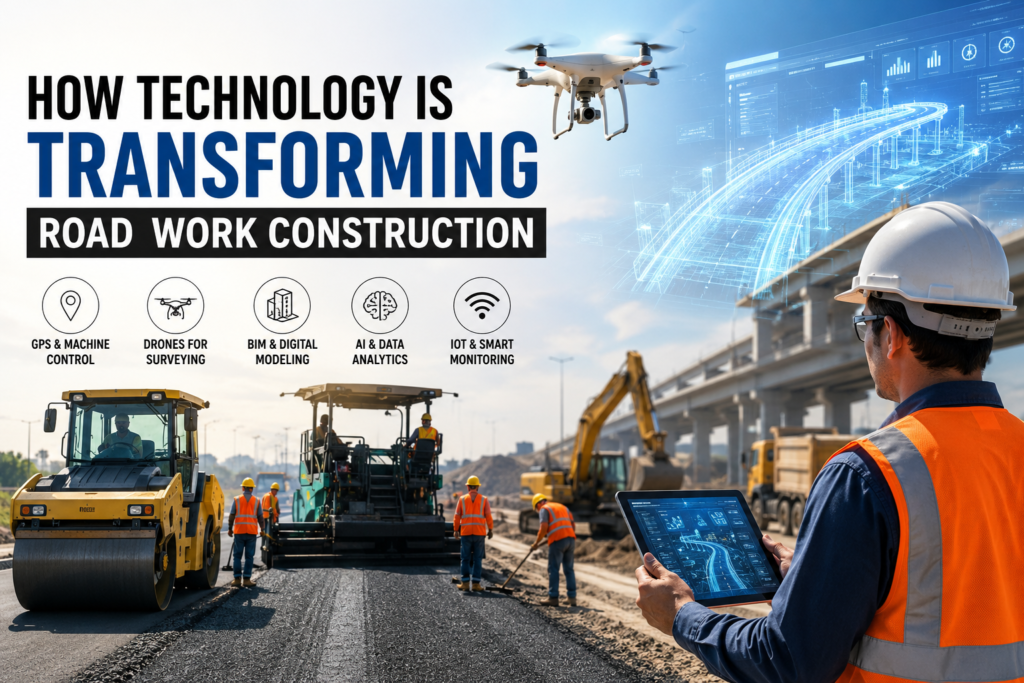
Road infrastructure is evolving rapidly as new technologies reshape the way roads are planned, built, and maintained. From smart surveying tools and GPS-guided machinery to drones and Building Information Modeling (BIM), technology is helping contractors deliver projects faster, safer, and with greater precision.
In today’s competitive construction industry, adopting modern technologies is no longer an option it’s a necessity. Whether constructing highways, urban roads, industrial access roads, or rural infrastructure, technology improves efficiency while reducing costs and minimizing project delays.
In this blog, we’ll explore how technology is transforming road work construction and why it is shaping the future of infrastructure development.
Why Technology Matters in Road Construction
Traditional road construction methods often involved manual surveying, paper-based planning, and labor-intensive processes. While these methods served their purpose, they were prone to delays, errors, and higher operating costs.
Modern technology offers several advantages, including:
- Improved project accuracy
- Faster construction timelines
- Better resource management
- Enhanced worker safety
- Reduced material wastage
- Higher-quality road infrastructure
By integrating digital tools and advanced machinery, contractors can complete projects more efficiently while maintaining high construction standards.
GPS and Machine Control Systems
GPS technology has become an essential part of modern road work construction.
Machine control systems use GPS data to guide heavy equipment with high precision, helping operators perform grading, excavation, and paving accurately.
Benefits of GPS Technology
- Accurate earthmoving
- Reduced rework
- Faster project completion
- Lower fuel consumption
- Improved material efficiency
This technology minimizes human error and ensures roads are constructed according to design specifications.
Drones for Surveying and Site Monitoring
Drones have revolutionized construction surveying and project monitoring.
Instead of relying solely on manual surveys, contractors now use drones to capture high-resolution aerial images and real-time project data.
Applications of Drones
- Land surveying
- Progress monitoring
- Volume calculations
- Site inspections
- Safety assessments
Drone technology saves time while providing accurate data for better project planning.
Building Information Modeling (BIM)
Building Information Modeling (BIM) allows engineers, architects, and contractors to collaborate using detailed 3D digital models before construction begins.
Advantages of BIM
- Better project visualization
- Improved coordination
- Early detection of design conflicts
- Reduced construction errors
- More efficient project planning
BIM improves communication between project teams and helps reduce costly modifications during construction.
Smart Construction Equipment
Modern road construction equipment is equipped with advanced sensors and automation features.
Examples include:
- GPS-enabled motor graders
- Intelligent asphalt pavers
- Automated road rollers
- Smart excavators
These machines improve accuracy, reduce operator fatigue, and increase productivity across construction sites.
Artificial Intelligence (AI) in Construction Planning
Artificial Intelligence is becoming increasingly valuable in infrastructure development.
AI helps contractors:
- Predict project delays
- Optimize construction schedules
- Estimate material requirements
- Improve equipment utilization
- Analyze project risks
By using AI-powered insights, construction companies can make faster and more informed decisions.
Internet of Things (IoT) for Equipment Monitoring
The Internet of Things (IoT) connects construction equipment through sensors that collect real-time operational data.
IoT systems monitor:
- Equipment health
- Fuel consumption
- Engine performance
- Maintenance schedules
- Machine utilization
This reduces unexpected equipment breakdowns and extends machinery lifespan.
Digital Project Management Software
Construction management platforms have replaced many manual project tracking methods.
These tools help teams manage:
- Project schedules
- Budgets
- Documentation
- Workforce coordination
- Material procurement
Cloud-based software enables real-time collaboration between office teams and site engineers.
Sustainable Road Construction Technologies
Technology is also making road construction more environmentally friendly.
Modern sustainable practices include:
- Recycled asphalt pavement (RAP)
- Warm mix asphalt
- Energy-efficient construction equipment
- Dust suppression systems
- Intelligent fuel management
These innovations reduce environmental impact while lowering operational costs.
Laser and 3D Scanning Technology
Laser scanning provides highly accurate measurements for road construction projects.
Benefits include:
- Detailed terrain mapping
- Accurate grading
- Quality inspections
- Faster site measurements
3D scanning minimizes errors and supports precise construction planning.
Predictive Maintenance Using Data Analytics
Instead of repairing equipment after failure, contractors now use predictive maintenance systems.
These systems analyze machine data to detect early signs of wear, allowing maintenance to be scheduled before major breakdowns occur.
Advantages include:
- Reduced downtime
- Lower repair costs
- Improved equipment reliability
- Better project continuity
Improved Worker Safety Through Technology
Technology has significantly improved safety on road construction sites.
Examples include:
- Wearable safety devices
- Smart helmets
- AI-powered surveillance cameras
- Collision avoidance systems
- Real-time worker location tracking
These technologies help reduce workplace accidents and improve emergency response.
The Future of Road Work Construction
Emerging technologies continue to reshape the construction industry.
Future innovations may include:
- Autonomous construction equipment
- AI-powered traffic management during construction
- Robotics for repetitive tasks
- Digital twins for infrastructure management
- Smart roads with embedded sensors
As these technologies become more widely adopted, road construction projects will become faster, safer, and more sustainable.
Conclusion
Technology is transforming road work construction by improving accuracy, efficiency, safety, and sustainability. Innovations such as GPS-guided machinery, drones, BIM, AI, IoT, and smart construction equipment are helping contractors deliver higher-quality infrastructure while reducing costs and project timelines.
Companies that embrace these technological advancements are better positioned to meet the growing demand for modern infrastructure. EVCO leverages advanced construction technologies, skilled professionals, and efficient project management practices to deliver reliable, high-quality road work solutions that support long-term infrastructure development.