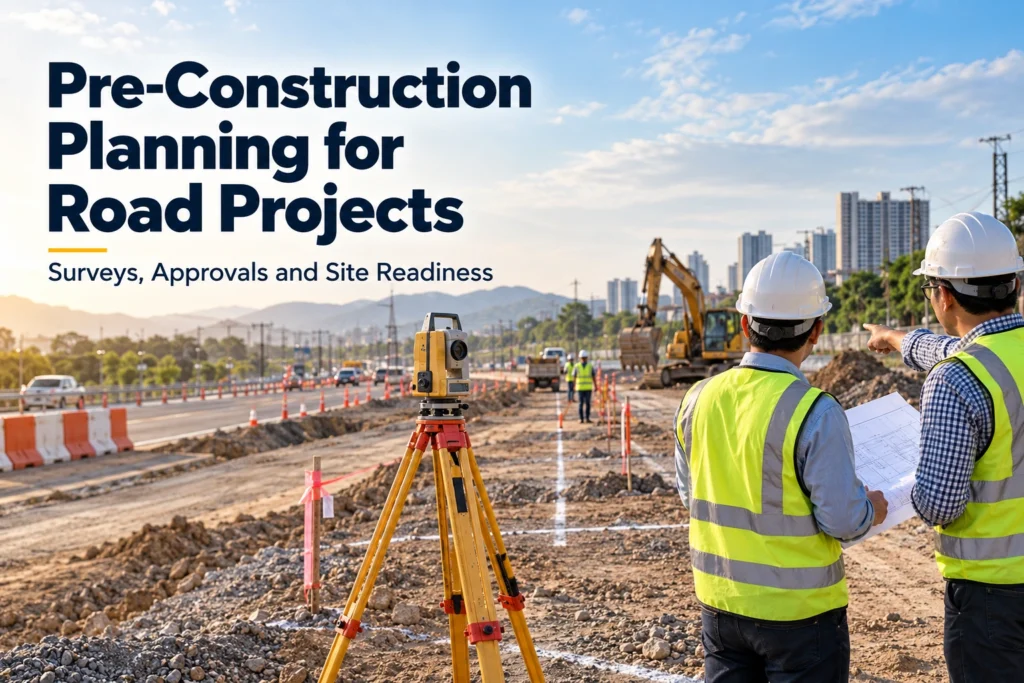
Road construction planning begins before mobilization. Surveys, approvals, utility coordination, materials, equipment, traffic management, drainage, safety and quality procedures all influence whether construction can proceed efficiently. EVCO’s pre-construction services reflect this: site survey, alignment, material and equipment planning and a detailed construction plan are the key early steps. This guide covers surveys, approvals and site readiness for road projects.
What is road construction planning?
Road construction planning converts design intent into an executable sequence. It connects drawings and specifications with site conditions, resources, approvals, programme, traffic arrangements, quality control and handover requirements.
Surveys before road construction planning begins
- Topographic surveys establish levels and features.
- Alignment surveys define the route and tie-ins.
- Utility investigations identify existing services.
- Geotechnical information helps establish subgrade and earthwork requirements.
- Drainage surveys identify flow paths, culverts and outfalls.
Approvals and stakeholder coordination in road construction planning
Road projects can involve municipal bodies, traffic authorities, utility owners, property owners and other stakeholders. The programme should allow time for drawings, permissions, traffic diversions and utility shifting; the exact approvals depend on project location and scope. A pre-construction meeting should clarify responsibilities, drawing status, approvals, access, working hours, inspection procedures and escalation routes, which matters most when multiple contractors share a corridor.
Site readiness checklist for road construction planning
Confirm approved drawings and specifications; survey control; available work fronts; verified utilities; traffic and pedestrian arrangements; drainage and temporary water management; materials; plant; manpower; safety systems; and inspection and testing procedures.
A formal ready-to-build gate is a useful management practice. Before authorizing the next stage, confirm drawings, survey control, approvals, utilities, materials, equipment, manpower, safety and inspection arrangements. For larger corridors, apply gates to each work front (survey complete, utilities cleared, excavation ready, installation tested, backfill approved, restoration complete) instead of releasing everything at once. For a wider checklist, read 10 Essential Things to Know About Road Work Construction Before Starting a Project.
Material and equipment planning
EVCO’s project information describes equipment such as asphalt plants, pavers, rollers, excavators, loaders, dumpers and concrete equipment. Equipment planning should consider production rates, site access, maintenance, backup requirements and sequence; see What Equipment Is Essential for Modern Road Work Construction? for more. Materials such as aggregates, asphalt, concrete and drainage components also need early attention: consider approved sources, testing requirements, transport, storage, seasonal constraints and lead times, and identify programme-critical materials first.
Drainage, levels and temporary water management
Drainage should be coordinated with the road profile before surface works. EVCO’s road-construction process places drainage in pre-construction and treats subgrade, sub-base, base, binder and surface courses as successive elements. Before opening a work front, plan how surface water will be kept away from excavation and newly prepared layers; temporary drains, pumps, berms or staged excavation may be required, especially during heavy rainfall.
Traffic management in road construction planning
Urban work often occurs beside traffic, businesses and pedestrians. The plan should define work zones, diversions, signage, barriers, working hours and emergency access. Mumbai conditions such as rainfall, traffic and dense underground utilities can increase complexity. For a formal example of documenting these measures, see this overview of work zone traffic management plans from the FHWA.
Quality-control planning
Define inspection points before construction: formation levels, compaction, aggregate quality, asphalt production, paving, thickness, density, surface regularity and final markings as applicable. Test records provide evidence for quality and handover.
Programme, sequencing and risk in road construction planning
A realistic programme accounts for monsoon periods, utility shifting, approvals, material lead times, access restrictions, traffic windows and possible design changes, and critical activities should have contingency plans. Road work is usually more efficient when sequenced around work fronts: survey, utility clearance, drainage, earthwork, sub-base, base and surfacing can be released in controlled sections so quality checks and traffic arrangements move with the programme. Large cut-and-fill operations can become the critical path, so connect earthwork quantities to the programme and sequence survey release, excavation, material testing, hauling, placement and compaction to keep equipment productive.
For each major risk (traffic, utilities, drainage, weather, access, material availability, equipment breakdown, public safety), define an owner, an early warning indicator and a response, so the risk register works as a management tool rather than paperwork.
Access, design coordination and communication
- Access and work fronts: A contractor may be technically ready but unable to work if the site is not available. Confirm access, possession, utility clearance, traffic arrangements and adjacent-contractor interfaces for each work front.
- Design coordination: Give the contractor the latest approved drawings before major work begins. A drawing register and revision control prevent crews from working from outdated information and avoid rework from late changes to alignment, pavement thickness, drainage or utility interfaces.
- Communication and reporting: A regular routine should track progress, quantities, tests, safety observations, constraints, approvals and upcoming activities, with clear decision owners and release criteria for each stage.
Handover, scope control and contractor selection
Define completion before construction begins: which surveys, test reports, as-built drawings, photographs, certificates and defect lists are required. Early agreement prevents physical work being complete while administrative handover remains unresolved. Before issuing a work order, reconcile the scope against drawings, site measurements, quantities, exclusions and assumptions, and agree how changes will be surveyed, priced and approved. Select a contractor on project experience, equipment capability, quality systems, safety procedures, programme capacity and references; see How to Choose Reliable Road Contractors in Mumbai. EVCO combines road construction, earthworks, underground installation and construction management. Final methods and specifications should be confirmed by the project engineer against actual site conditions, drawings and applicable standards.
Quick Comparison / Project Checklist
| Area | Confirm | Risk if missed |
|---|---|---|
| Survey | Levels/alignment/utilities | Rework |
| Approvals | Permissions | Work stoppage |
| Drainage | Flow/levels | Water damage |
| Materials | Source/quality | Delay |
| Equipment | Capacity/access | Low productivity |
| QA/QC | Tests/inspection | Quality disputes |
Start Road Construction Planning Early to Avoid Costly Delays
Strong road construction planning reduces avoidable delays because the project team resolves major constraints before physical work begins. Treat surveys, approvals, utility coordination, drainage, resources and quality controls as prerequisites rather than parallel afterthoughts.
Planning a road project and want a clear pre-construction plan? Share your drawings, site details and programme with our team and get a practical roadmap before you mobilize. Contact EVCO today, or explore our road construction services and see why project teams choose EVCO.
Frequently Asked Questions
What is road construction planning and pre-construction planning?
It establishes surveys, approvals, resources, sequencing, safety and quality controls before physical road work.
What surveys may be needed?
Depending on scope, topographic, alignment, utility, drainage and geotechnical surveys can be required.
Why check utilities first?
Unknown services can cause safety incidents, service interruptions, redesign and delays.
When should drainage be planned?
It should be coordinated with alignment, levels and pavement design before paving.
What equipment is commonly needed?
Projects may require excavators, loaders, dumpers, graders, rollers, pavers and production equipment depending on scope.
How can road construction planning delays be reduced?
Resolve approvals, utilities, drawings, materials, access, traffic management and equipment planning before mobilization.