Road rehabilitation decisions should be based on the condition and performance of the complete pavement, not simply on how worn the surface looks. A road may need only localized repairs and resurfacing when the underlying structure remains sound. In contrast, widespread structural distress, settlement, drainage failure or weak subgrade can make reconstruction the more appropriate intervention. EVCO’s road-construction guidance presents planning, site analysis, subgrade preparation, drainage, base, binder and surface courses as connected stages of successful road work.
What Is Road Resurfacing?
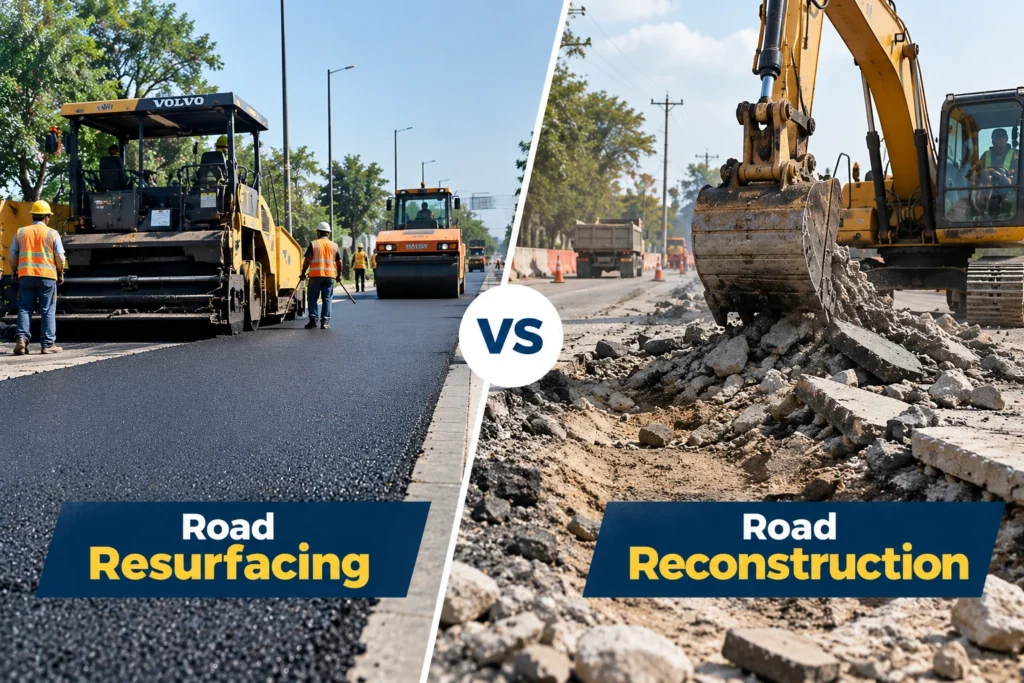
Road resurfacing generally means repairing and preparing an existing pavement and placing a new surface layer, such as an asphalt overlay. Depending on condition, preparation may include milling, patching, leveling, crack treatment or localized reconstruction. Resurfacing is most effective when the existing pavement still has adequate structural capacity and the main problem is surface deterioration.
What Is Road Reconstruction?
Road reconstruction is a deeper intervention. Distressed pavement layers may be removed and rebuilt, with the scope potentially extending through the surface, base, sub-base and unsuitable subgrade. Reconstruction requires more excavation, material movement and traffic management, but it can address failures that an overlay cannot permanently solve.
Surface Distress vs Structural Failure
The first project question is whether the defect is mainly superficial or structural. Surface oxidation, minor cracking and limited wear may be compatible with resurfacing. Deep rutting, widespread fatigue cracking, settlement, pumping, repeated potholes and drainage-related failures can indicate a deeper problem. A condition survey should therefore look beyond the visible surface.
How Teams Assess an Existing Road
A practical assessment includes visual condition mapping, traffic loading, drainage, road levels, maintenance history and, where required, investigation of pavement layers and subgrade. Repeated repairs at the same locations are especially useful clues. The assessment should identify whether water, weak support or construction defects are contributing to deterioration.
When Resurfacing May Be Appropriate
Resurfacing may be suitable where the pavement structure is generally serviceable, defects are concentrated near the surface, drainage is functional or can be corrected, and the proposed overlay can meet expected traffic and service-life requirements. Milling or localized repairs may be needed before the overlay.
When Reconstruction May Be Better
Reconstruction becomes more likely when structural distress is widespread, the base or sub-base has lost capacity, settlement is significant, water continues to enter pavement layers, or repeated overlays have created level and drainage constraints. The goal is to correct the cause, not simply cover the symptom.
Why Drainage Can Decide the Outcome
Water is a major contributor to pavement deterioration. EVCO’s road-construction guide places drainage installation in the pre-construction phase and explains that drainage prevents water accumulation and road damage. A new surface over an unresolved drainage problem can therefore provide only temporary improvement.
Resurfacing vs Reconstruction: Cost, Time and Risk
Resurfacing is often less disruptive when the existing structure is adequate, while reconstruction requires deeper excavation and rebuilding. However, the lowest initial quotation is not necessarily the lowest lifecycle cost. A thin intervention that fails quickly can lead to repeated traffic management, patching and another resurfacing cycle, while full reconstruction can be unnecessary expenditure if the existing pavement is structurally sound.
Compare initial construction, expected maintenance, disruption, material quantities and likely service life before choosing. For a broader view of how preservation, rehabilitation and reconstruction compare, see FHWA’s performance evaluation of rehabilitation and preservation treatments.
How to Assess an Asphalt Overlay
Overlay thickness should not be selected by appearance alone. Consider existing pavement condition, traffic, levels, drainage, material specification, construction sequence and interfaces with kerbs, entrances and utilities. Where necessary, milling can correct levels and remove unsuitable surface material before paving.
Road Resurfacing Project Assessment Checklist
Confirm each of the following, and clearly mark locations where deeper repairs are required:
- Condition survey and traffic demand
- Drainage, pavement structure and road levels
- Localized repair requirements and overlay strategy
- Material specifications and compaction requirements
- Traffic management and testing plan
Maintenance History Matters
The pattern of previous repairs can reveal recurring failure mechanisms. A pothole repeatedly repaired in the same location may indicate water infiltration, weak subgrade or a localized structural defect. Reviewing maintenance records with the condition survey can prevent another cycle of short-lived patching.
Project Scope, Quality Control and Handover
The scope should identify milling, patching, overlay thickness, reconstruction areas, drainage, kerbs, utility interfaces, traffic management and testing. Before issuing a final work order, reconcile it against drawings, site measurements, quantities, exclusions and assumptions. A written technical scope gives both the owner and contractor a clear baseline for execution and variation control.
Quality control should verify materials, levels, thickness, compaction and finished surface condition. Plan records from the start: survey records, material certificates, test reports, inspection requests, photographs and as-built information form a handover package the owner can use for maintenance and future work.
Post-work inspection
After resurfacing or reconstruction, inspection should verify finished levels, surface regularity, drainage, pavement thickness where specified, markings and tie-ins. EVCO’s road-construction guidance includes inspection and testing before opening a completed road and ongoing maintenance after completion.
Traffic and Access Planning
The intervention must also fit the road’s operational environment. A major urban corridor may require staged construction, night work or traffic diversions, while an internal industrial road may permit a different sequence. Access to properties, emergency routes, pedestrian movement and nearby businesses should be considered before selecting the construction method.
How to Decide: A Simple Decision Matrix
A practical road-intervention matrix scores five areas. It should support engineering judgement, not replace it.
| Area | What it indicates |
|---|---|
| Surface condition | If surface condition is poor but structural capacity is acceptable, resurfacing can be considered. |
| Structural capacity | If structural capacity is inadequate, reconstruction becomes more likely. |
| Drainage | If drainage is the root cause, include drainage work regardless of the chosen pavement treatment. |
| Traffic loading | Current and future traffic, particularly heavy vehicles, influence pavement design and intervention choice. |
| Desired service life | Compare each option’s expected service life against its lifecycle cost. |
Choosing a Contractor and Managing Risk
Good contractor selection should include relevant project experience, equipment capability, quality systems, safety procedures, programme capacity and references. EVCO presents road construction, earthworks, underground services, pre-construction and construction management among its infrastructure capabilities.
Risk management works best when it identifies practical site constraints before mobilization: traffic, utilities, drainage, weather, access, material availability, equipment breakdown, public safety and stakeholder coordination. For each major risk, define an owner, an early warning indicator and a response.
Before awarding the work, the client should be able to answer five questions:
- What exactly is being built or repaired?
- What existing conditions have been verified?
- Which approvals and interfaces are outstanding?
- How will quality be measured?
- What constitutes completion and handover?
Final methods and specifications depend on actual site conditions, approved drawings and applicable standards. This guide is written as buyer and project-team education; final pavement sections, earthwork quantities, utility methods and drainage details should be confirmed by the project engineer.
Quick Comparison
| Factor | Resurfacing | Reconstruction |
|---|---|---|
| Main purpose | Restore/upgrade surface | Restore pavement structure |
| Existing structure | Generally serviceable | Significantly distressed/inadequate |
| Disruption | Lower | Higher |
| Drainage | Must be adequate/corrected | Can be rebuilt with pavement |
| Decision basis | Condition + structure | Structural/geotechnical assessment |
Choose the Right Fix, Not Just the Quickest One
The choice between road resurfacing and reconstruction should follow evidence from pavement condition, structure, drainage, traffic and expected service life. A professional assessment helps you spend on the intervention that addresses the road’s actual failure mechanism, instead of covering a symptom that returns.
EVCO brings decades of experience in infrastructure construction and maintenance, and can help you move from assessment to a clear scope and well-executed road work.
Planning a road repair, resurfacing or reconstruction project? Contact EVCO today to discuss your site and request a free quote, or explore our road construction services. Get the right intervention specified before the work begins.
Frequently Asked Questions
Is road resurfacing cheaper than reconstruction?
It is often less resource-intensive when the pavement structure remains sound, but the correct option depends on the actual defects and scope.
How do I know if a road needs reconstruction?
Widespread structural cracking, settlement, deep rutting, repeated failures and drainage-related deterioration can indicate a need for deeper intervention.
What is an asphalt overlay?
It is a new asphalt layer placed over a prepared existing pavement. Its suitability depends on existing condition and structural capacity.
Can resurfacing permanently fix potholes?
Only when the cause is addressed. Potholes caused by deeper structural or drainage problems may require deeper repairs.
Why is drainage important?
Water can weaken pavement layers and accelerate deterioration, so drainage defects should be corrected as part of rehabilitation.
Should traffic be considered?
Yes. Current and future traffic, particularly heavy vehicles, influence pavement design and intervention choice.