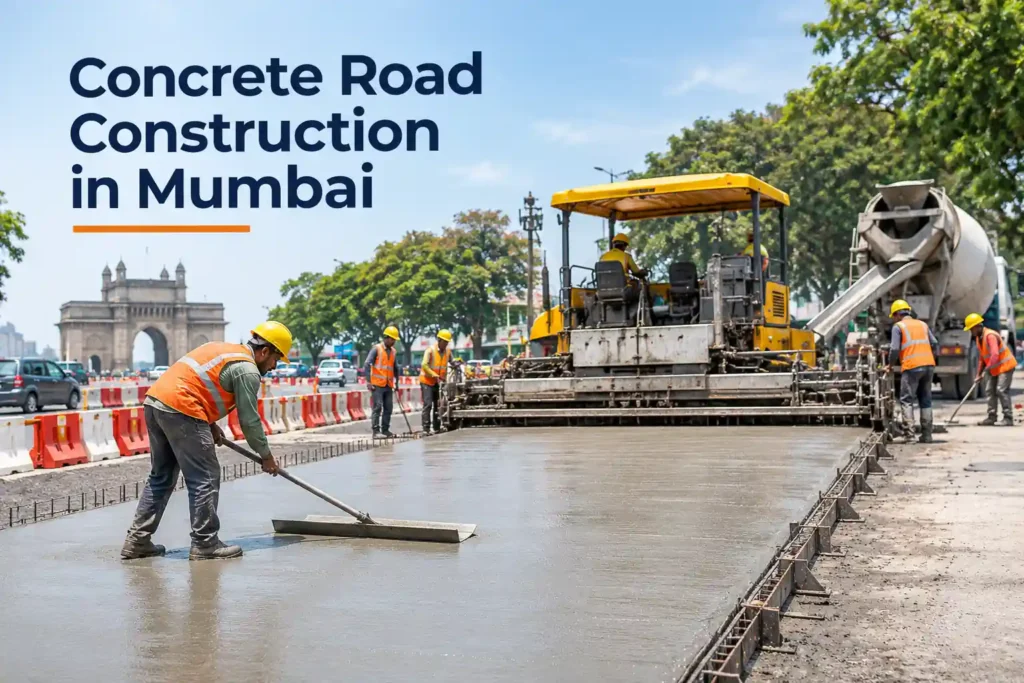
Concrete road construction in Mumbai is gaining ground because concrete roads, when designed and built properly, hold up to the monsoon far better than most bitumen surfaces. Mumbai’s heavy rain, waterlogging and constant traffic are exactly the conditions that turn bitumen roads into potholes, and that is why the city’s civic body has moved major roads to concrete. This guide explains how concrete roads compare with bitumen roads, where concrete makes sense, what the trade-offs are and how a contractor should approach the work. Read about EVCO’s road construction services for Mumbai projects.
Why concrete road construction in Mumbai is rising
Mumbai receives most of its rain in a few months, and standing water is the main enemy of a bitumen road. Water enters cracks, weakens the base and breaks the surface, and each season brings another round of patching. According to a report by the Concrete Pavements publication, the BMC planned to convert 400 km of major roads from asphalt to concrete, with the stated aim of ending the city’s pothole problem and lowering long-term maintenance costs, and with contractors responsible for maintaining the roads for 10 years. That decision shows how seriously the city views concrete as a durable answer to monsoon damage.
Concrete roads vs bitumen roads
Each material has strengths. The table below gives a practical comparison for urban use. Actual performance depends on design, materials, drainage and workmanship.
| Factor | Concrete road | Bitumen road |
|---|---|---|
| Monsoon performance | Resists water damage better when joints and drainage are right | More prone to potholes when water reaches the base |
| Maintenance | Generally lower, with periodic joint and crack attention | Frequent patching and resurfacing |
| Initial cost | Usually higher | Usually lower |
| Construction time | Needs curing time before traffic is allowed | Can often open to traffic sooner |
| Repair after utility cuts | Harder, since cutting concrete is more work | Easier to patch |
| Surface and ride | Rigid, long-lasting surface; quality depends on finishing | Flexible, easier to resurface |
Why concrete road construction in Mumbai suits the city
- Heavy rain and waterlogging: a properly drained rigid pavement copes better with standing water.
- Heavy and constant traffic: buses, trucks and stop-start traffic put heavy load on surfaces.
- Lower repair disruption: fewer repairs means fewer closures and less congestion over the life of the road.
- Long-term cost: a higher upfront cost can pay back through lower maintenance.
Where concrete road construction in Mumbai works best
Concrete suits roads with heavy traffic, flood-prone stretches, junctions, bus corridors and internal roads in industrial estates, campuses, ports and airports. EVCO’s website lists clients and work in infrastructure, including airport and industrial environments, and describes its range from highways and bridges to parking lots and driveways. Bitumen may still be the better choice for light-duty lanes, short-term needs, tight budgets or areas where frequent utility work is expected. The key is to match the pavement to the traffic, the drainage and the budget.
How concrete road construction in Mumbai is done
- Survey and design: assess traffic, soil and drainage, then design thickness, joints and reinforcement.
- Utilities and drainage first: plan and complete underground work before paving, since cutting concrete later is hard. See EVCO’s notes on underground utility installation in urban roads.
- Earthwork and subgrade: excavate, level and compact a stable base. See earthwork services.
- Sub-base and formwork: lay and compact the sub-base and set accurate formwork.
- Concrete placing and finishing: place, compact, finish and texture the concrete.
- Joints and curing: cut joints at the right time and cure properly so strength develops.
- Opening and maintenance: allow traffic only after the required strength and seal joints regularly.
Quality checks that decide how long concrete roads last
A concrete road lasts only as long as its weakest step. Good practice includes tested concrete mix, correct thickness and joint spacing, adequate drainage, proper compaction of the base and careful curing. Third-party quality supervision helps; the BMC project mentioned above appointed a full-time quality management agency to oversee construction. When you hire a contractor for a private or industrial road, ask about mix design, testing frequency, curing method and who signs off each stage.
Budget and timeline for concrete road construction in Mumbai
Cost depends on length, width, thickness, traffic class, drainage, utilities, site access and the monsoon calendar. Concrete usually costs more upfront than bitumen, so compare the life-cycle cost, including repairs and closures, rather than the initial price. Work should be planned around the monsoon, since rain affects placing, curing and traffic management. For a general view of timelines and approaches, see EVCO’s guide to 10 essential things to know about road work construction.
Concrete or resurfacing: making the right choice
Not every damaged road needs full reconstruction. If the base is sound, resurfacing can restore the surface at lower cost. If the base has failed repeatedly, concrete may be a better long-term answer. Read road resurfacing vs reconstruction to understand how project teams decide.
Choosing a contractor for concrete roads
Look for experience on large infrastructure projects, access to the right equipment, a clear quality plan and a record of work you can inspect. EVCO (Eapen Varghese & Co.) is based in Andheri West, Mumbai, and states decades of experience in infrastructure and road construction, with 1000+ completed projects. You can review the project gallery and the list of works and learn how modern road construction equipment improves efficiency.
Common mistakes in concrete road construction in Mumbai
Most early failures trace back to a few avoidable errors. Skipping drainage design lets water collect at the edges and weaken the base. Cutting joints too late or too shallow leads to random cracks. Poor curing in hot or windy weather dries the surface too fast, and opening the road to traffic before the concrete has gained strength causes damage that is expensive to fix. Another frequent problem is paving first and digging for utilities later, which leaves patched strips across a new surface. Agree the drainage plan, utility sequence, joint layout and curing method in writing before work begins, and keep inspection records for each stage.
Explore More from EVCO
Use these links to go straight to the services and guides mentioned in this article.
Services: Road construction | Earth works | Pre-construction | General contracting | Construction management | Pickleball courts | Underground installation | Light commercial construction | Infrastructure development
Guides: Road resurfacing vs reconstruction | 10 things to know about road work | Underground utilities in urban roads | Road construction equipment in Mumbai
Plan concrete road construction in Mumbai with EVCO
Concrete road construction in Mumbai makes sense where monsoon damage, heavy traffic and repeated repairs have made bitumen costly to keep up. Success depends on good design, sound drainage, quality control and a contractor who plans around utilities and the rainy season. EVCO offers road construction, earth works and related services for commercial, industrial and infrastructure projects in Mumbai.
Planning a concrete road for your site or society? Call 022 26244934 or +91 9833365945 (Mon–Sat, 8am–7pm), email info@evco.co.in or contact EVCO online and the EVCO team will respond with the next steps.
Frequently Asked Questions
Why is concrete road construction rising in Mumbai?
Heavy monsoon rain and traffic damage bitumen roads quickly, and concrete roads are expected to need less maintenance when well built. The BMC has planned large-scale conversion of major roads.
Do concrete roads outlast bitumen roads?
When designed, drained and built properly, concrete roads generally last longer between major repairs. Poor workmanship or drainage can shorten the life of either type.
Is concrete costlier than bitumen?
Concrete usually costs more upfront, but lower maintenance can reduce the long-term cost. Compare life-cycle cost, not only the first price.
When can traffic use a new concrete road?
Concrete needs curing time before it gets full traffic. The exact period depends on the mix, thickness and site conditions, so follow the engineer’s direction.
Are concrete roads harder to repair?
Yes, utility cuts and repairs take more effort than patching bitumen. That is why underground services should be completed before paving.
When is bitumen still better?
For light traffic, tight budgets, short-term needs or areas expecting frequent utility work, bitumen can be more suitable.
What quality checks should I ask for?
Ask about mix design, concrete testing, thickness, joint spacing, drainage, base compaction and curing method.
Can roads be built during the monsoon?
Rain affects placing and curing, so work is usually planned around the monsoon or protected carefully.
Does EVCO build roads in Mumbai?
Yes. EVCO lists road construction among its services and is based in Andheri West, Mumbai.
How do I get a quote?
Call 022 26244934 or +91 9833365945, email info@evco.co.in or use the contact page with your site details.